

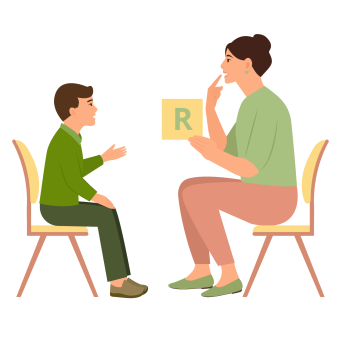
Developmental Screening
A structured first session that flags areas of concern across reading, language, attention, sensory and social-emotional development.
Ages:3 – 18Format:1 session, 90 minOutcome:Referral letter
Care Pathways
Most centers stop at diagnosis. NEST is built around the idea that screening, evaluation, therapy and lifelong guidance are four parts of one conversation, carried by the same team, in the same record.
A structured first conversation to surface what's really going on, for the child, the family, and the school.
A full multidisciplinary panel, psychology, speech, OT and education, convened around one shared file.
Weekly 1:1 work in the modalities that match the plan, at the clinic, at home, online, or alongside the school.
Reviews every 6 months, transition planning at every life stage, and a clinician who keeps the long view.
Our Services
Services run as a connected ecosystem, your speech therapist sees the OT's notes, the educator follows the same goals, and the case lead reviews progress regularly.
A structured first session that flags areas of concern across reading, language, attention, sensory and social-emotional development.
Multidisciplinary panel: cognitive, academic, language, OT and behavioural, packaged into one written report with a plan.
Articulation, receptive/expressive language, social communication, AAC, and bilingual phonology, in Urdu and English.
Sensory integration, fine motor, handwriting, self-regulation, and daily-life routines, in clinic and through home programs.
Targeted remedial work for dyslexia, dysgraphia and dyscalculia, aligned to the child's school curriculum, not a parallel one.
Caregiver coaching, sibling sessions, parent groups and crisis support, because the family is part of the team.
Classroom observation, teacher consultation, accommodation letters and IEP support, so school and clinic stay in sync.
Late-diagnosis support, executive functioning coaching, transition planning and workplace accommodations for ages 16+.
Specialized Programs
Five focused programs, each with its own assessment protocol, therapy team and review cadence. Pick the closest fit — the team will refine the plan after intake.
A structured-literacy program for readers who learn differently. We combine assessment, weekly 1:1 work and classroom alignment so reading gains transfer outside the clinic.
By Age
NEST supports individuals from age 2 through adulthood. The modalities change with the life stage, the team and the record do not.
Hover a band to read more, every plan is personalised, but here's the typical shape.
Screening, early language & sensory work, parent coaching during the highest-impact window.
Diagnosis, literacy and learning support, school liaison and weekly therapy.
Executive functioning, exam accommodations, identity & social work, transitions.
Late diagnosis, workplace strategy, university support and group sessions for adults.
Where Care Happens
Care meets the family where it makes sense. The setting changes, the clinical lead and the case file stay the same.
Therapy rooms, sensory gym, observation suite and assessment space at our Lahore center.
Therapists visit for early-years work and family coaching when the home is the right setting.
Classroom observation, teacher consultation and accommodation planning across partner schools.
Tele-therapy for ages 8+ in the modalities that translate well to a screen — including for the diaspora.
How To Start
Most families are seen within two to three weeks of the first call. Here's exactly what happens, no insurance pre-auth, no diagnostic gatekeeping.
A short form or call so we understand what's prompting the visit.
A 30-min conversation with our case lead, free of charge.
In-person session covering the indicators flagged in intake.
Written plan, family meeting, and the team that will own it.
Therapy starts, with 6-month reviews built into the plan.
FAQs
Still wondering about something? Email and a case lead will reply within one working day.
No. Families can book a screening directly, most of ours come without a referral. If you have a school or paediatrician letter, bring it; if not, that's fine.
A diagnostic evaluation runs across three to four sessions over two to three weeks, followed by a written report within 14 days and a family meeting to walk through it.
We work with individuals from age 2 through adulthood. The team and modalities adapt to the life stage, early intervention, school-age therapy, adolescent transitions and adult pathways.
Therapy is scheduled after school where possible. For programs that overlap school hours, we coordinate with the school directly, and our liaison team writes the accommodation letter.
Yes, for ages 8+ and for modalities that translate well to a screen. We also work with families abroad through our online pathway.
Screening and intake are flat-fee. Therapy is billed per session, with subsidised slots reserved through our scholarship fund. Full fee schedule is shared at intake.